Edward Francis
Pigot, Priest-Scientist, 1858-1929
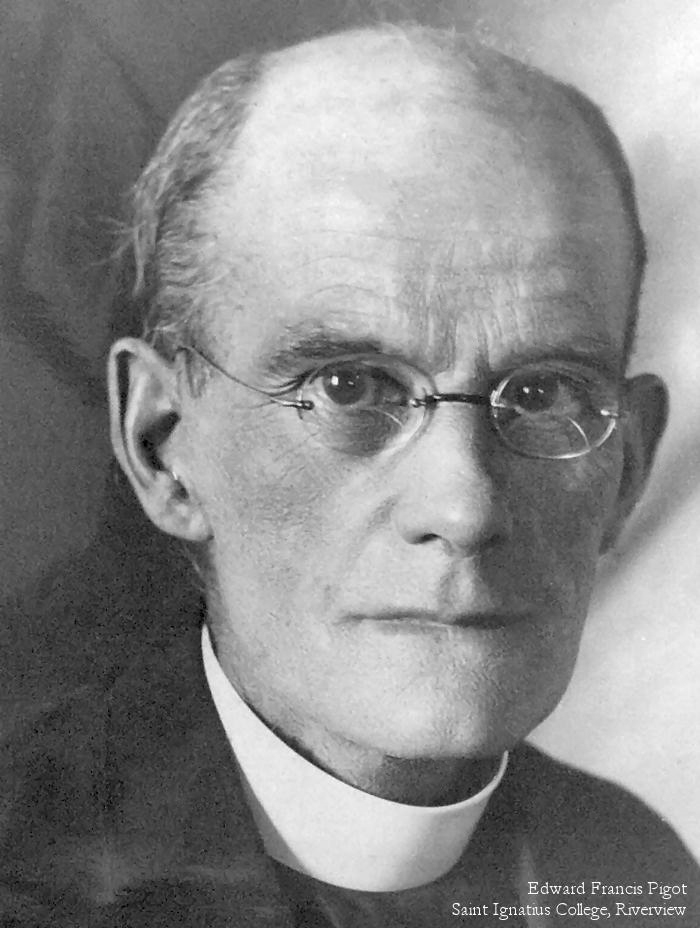 Edward
Pigot
is
an understated and unique individual in Australia's scientific
history. His extraordinary career is summarised at
websites such as the Australian
Dictionary
of
Biography, and Wikipedia.
A
very readable brief account of his career is also published by
the Geological
Society
of
Australia. Pigot's scientific and personal legacy is
a research interest of Dr. David
Branagan, who has authored a detailed account of Pigot's
career, which was recently published in the The
Journal of the History of Earth Sciences Society.
This paper was published in two parts (Vol. 28, No. 1, 2010, pp
69-99, and Vol 29, No. 2, 2010, pp 232-263). This journal
is held at U. Sydney main library. Details of his
career were presented at his very well attended Sydney funeral,
written up in The
Catholic Press weekly edition of 30 May
1929, page 20.
Edward
Pigot
is
an understated and unique individual in Australia's scientific
history. His extraordinary career is summarised at
websites such as the Australian
Dictionary
of
Biography, and Wikipedia.
A
very readable brief account of his career is also published by
the Geological
Society
of
Australia. Pigot's scientific and personal legacy is
a research interest of Dr. David
Branagan, who has authored a detailed account of Pigot's
career, which was recently published in the The
Journal of the History of Earth Sciences Society.
This paper was published in two parts (Vol. 28, No. 1, 2010, pp
69-99, and Vol 29, No. 2, 2010, pp 232-263). This journal
is held at U. Sydney main library. Details of his
career were presented at his very well attended Sydney funeral,
written up in The
Catholic Press weekly edition of 30 May
1929, page 20.
Dr. Branagan's 2009 radio broadcasts discussing Pigot's career,
caught my attention, particularly Pigot's abortive attempts at
measuring Earth tides down mine shafts at Cobar,
NSW. Measuring Earth tides is tricky even with all
the advantages of modern seismic instrumentation, and would have
been extremely challenging in Pigot's day. I was so taken
by Dr. Branagan's lively account of this extraordinary
priest-scientist, that I have named my modest seismic
observatory in his honour, the Edward Pigot Seismic
Observatory. This
should not be confused with seismic, astronomical and
meteorological observatories that Pigot established at Saint
Ignatius'
College,
Riverview, Sydney. These observatories and their
educational function at Riverview, continue
operations to this day.